If you own a Seattle home built before 1950, whether it’s a Capitol Hill Craftsman, a Wallingford foursquare, or a Ballard bungalow, it’s likely that the original electrical system is still at least partially in place. Knob-and-tube wiring was the standard for residential construction from the late 1800s through roughly the 1940s which means millions of homes across the country were wired this way. In Seattle’s older neighborhoods, it’s still hiding inside a lot of walls!
Most homeowners learn about knob and tube the same way: a home inspector flags it during purchase or an electrician finds it while running a new circuit. What comes next is usually a lot of questions: is it dangerous? Does it have to be replaced? Can I still get insurance? The answers are more nuanced than you might expect!
Does Your Seattle Home Still Have Knob-and-Tube Wiring? Here’s What You Need To Know
What Knob-and-Tube Wiring Actually Is
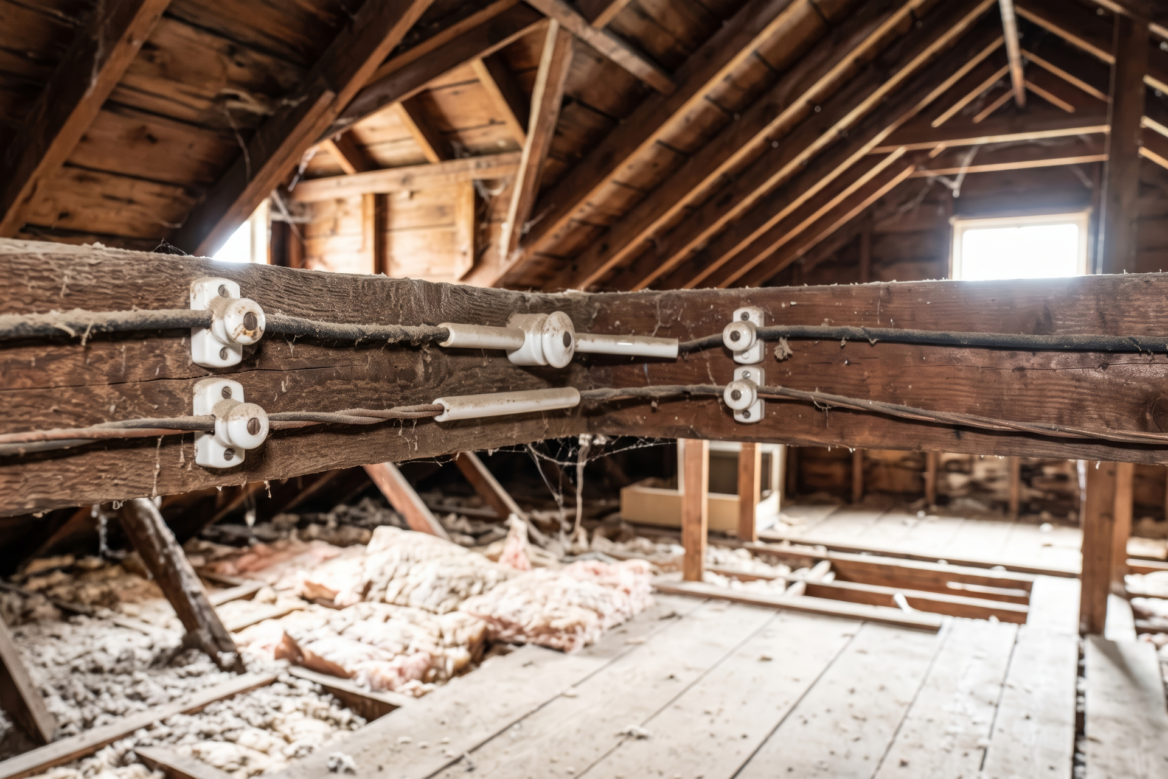
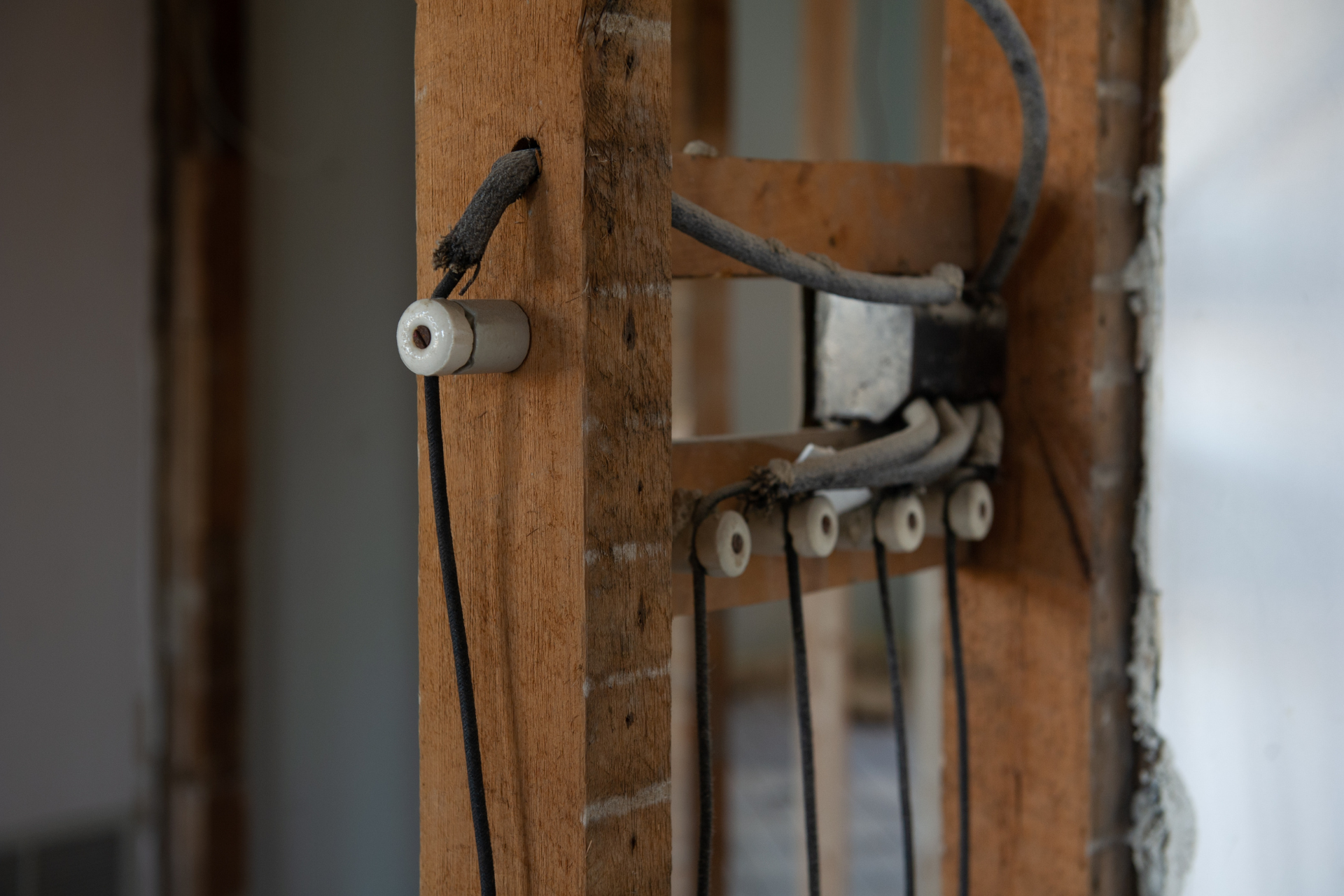
Knob-and-tube (K&T) wiring uses two separate conductors (one hot and one neutral) running independently through the framing rather than in a sheathed cable. The wires are routed through ceramic knobs (which anchor them to the framing) and ceramic tubes (which protect them where they pass through joists and studs). The system was well-suited to the technology and building practices of that era: it dissipates heat effectively because the individual conductors have air space around them and the ceramic insulators last essentially forever.
What K&T doesn’t have is a ground wire. Modern electrical systems use three-conductor wiring (hot, neutral, and ground) which provides a path to safely dissipate fault current and allows three-prong outlets. Knob-and-tube is inherently a two-wire system. It can’t support grounded outlets without a retrofit and it can’t safely handle the electrical loads of a modern home without careful management.
See also: What to Tackle First When You Own an Older Seattle Home

Safety Concerns of Knob-and-Tube Wiring
Original knob-and-tube wiring that’s been left alone and is in good condition isn’t inherently dangerous. The system itself, when installed correctly and untouched, functions as designed. The problems arise from what typically happens to K&T over the course of its life.
Insulation Installed Over It
This is by far the most serious safety concern with knob-and-tube wiring. Basically, K&T depends on open air circulation to dissipate heat; the conductors are designed to run freely through an air space. When insulation is added to an attic or wall cavity that contains K&T wiring, that heat dissipation is eliminated. The wire then runs hot, accelerates degradation of the insulation covering the conductors, and creates a fire risk. Many Seattle homes have added attic insulation at some point, so if the K&T is there, it need to be assessed before and after any insulation work.
Amateur modifications
We’ve found that knob-and-tube wiring has typically been in place long enough that most homes with it have had multiple owners who’ve had electrical work done over the years. Modifications such as splices made in wall cavities rather than junction boxes, connections made with the wrong materials, or circuits extended beyond their capacity are the most common source of problems we find when opening up walls in pre-war Seattle homes. The original K&T may be fine, but the homeowner modification from 1975 is what needs to go.
Aging insulation
The rubberized cloth insulation on original K&T wiring has a finite lifespan, and, after 80+ years, it’s often brittle and cracked. Insulation that’s degraded to the point of flaking off is a shock and fire hazard, particularly in areas where the wiring is accessible, like attics and basements, where it can be disturbed.
See also: Revitalize Your Home With a Design Build Company
The Insurance Problem
Many Seattle homeowners learn about the K&T issue not from an electrician, but from their insurance company. Homeowners insurers have taken an increasingly hard line on knob-and-tube wiring over the past decade or two. Here are a few common scenarios:
- Your insurer requires an electrical inspection and, upon finding K&T, requires replacement or modification as a condition of coverage.
- You’re purchasing a home and the insurer won’t write a policy at standard rates until the K&T is updated.
- Your existing policy comes up for renewal and the insurer adds a K&T exclusion, reducing coverage for electrical-related losses.
It’s also worth nothing that not every insurer handles this the same way. Some will cover a home with documented, inspected K&T at a premium surcharge. Others require full replacement as a condition of any coverage. It’s worth having a direct conversation with your insurer about what they require, ideally before you close on a home that has it.
When Replacement Is Required vs Discretionary
There’s actually no blanket rule that knob-and-tube wiring must be replaced in Seattle. The electrical code allows existing K&T to remain in place as long as it’s in good condition and properly maintained. Here are a few scenarios that could trigger a required replacement or modification:
- Opening a permit for electrical work in the affected area: in most cases, any permitted electrical work in a portion of the home requires the wiring in that area to be brought to current code.
- Adding insulation to spaces containing K&T: the permit will require the K&T to be removed or replaced before insulation is installed.
- Adding a circuit to an existing K&T panel or extending a K&T circuit: this can’t be done cleanly under current code and generally requires upgrading.
- Converting a basement or attic to finished living space: the electrical work required for this type of work often requires that K&T be upated to current code requirements.
Discretionary replacement, which is basically replacing K&T that could legally remain, is worth considering if you’re planning any significant work on the home, if the wiring is in areas that are hard to access and assess regularly, or if your insurance situation makes it the path of least friction.
Why a Remodel Is the Right Time
Electrical replacement in an older home is invasive work. Running new wiring means opening walls, ceilings, and floors at multiple points, patching the openings, and then repainting. As standalone work, it’s expensive and disruptive. But when you’re already opening walls for a kitchen remodel, a bathroom renovation, a basement conversion, or any other significant project, the walls are already open.
We see this a lot in older Seattle home projects. For example, a kitchen remodel in an old Fremont house opens the walls and finds K&T running through the kitchen, dining room, and into the attic. Rather than closing everything up and scheduling a separate electrical project that would require reopening the same walls, we address the K&T as part of the current scope. The marginal cost of electrical work is significantly lower when the access is already there.
If you’re planning a remodel of any significance in a pre-1950 Seattle home, it’s worth asking your electrician or design-build team to assess the electrical system at the start of the project rather than discovering K&T mid-construction.
What Replacement Actually Involves
Replacing knob-and-tube wiring means running new modern wiring from the panel to each circuit in the affected area. The old K&T conductors are disconnected at both ends and left in place because pulling them out could cause more damage than leaving them. New outlets and switches are then replaced with grounded three-prong versions. The panel may also need upgrading if it’s original to the home since many pre-war panels have capacity or safety issues of their own.
A full rewire of a pre-war Seattle home is a substantial project. We tell our clients to expect several weeks of work and a cost that varies based on the size of the home, the number of circuits, and how accessible the framing is. Partial rewires targeting specific areas of the home are also common and often the most practical approach when combined with a focused remodel scope.
Curious about your older Seattle home? Contact CRD Design Build to schedule a consultation. If you’re planning a remodel of an older Seattle home, we’ll assess the electrical system as part of the process and make sure you know what you’re working with before construction begins!