Updated October 2026 with current Seattle permit rules, fees and sources.
If you are a Seattle homeowner contemplating a kitchen remodel, you may be wondering if you will need to permit your project. In most cases, the answer is yes.
A good rule of thumb to determine whether you will need permits for a kitchen remodel is whether you will be touching anything behind the walls or in the floor. Seattle’s electrical code makes it unlawful to install, alter, or extend wiring without a permit, and King County requires a permit whenever you install, relocate, or change a plumbing or gas piping system. You’ll also most likely need a permit if you are removing or adding walls, because the city requires one for any work on load-bearing supports.
For all but the most cosmetic upgrades, you will likely need a permit. In fact, you may need three permits.
Before going any further, I need to mention that you should always check with the Seattle Department of Construction and Inspections (SDCI) before you start any remodeling project, even if you are just planning a relatively cosmetic kitchen upgrade. For plumbing and gas work, check with King County Public Health, which issues those permits inside Seattle.
For projects of $6,000 or less, you may not need a permit
Most building projects in Seattle require a permit, but there are some exceptions for very minor repairs and projects. According to the City of Seattle:
You don’t need a permit for minor repairs or alterations that cost $6,000 or less in any 6-month period. The $6,000 limit is based on fair market value of labor and parts, even if you do the work yourself.
But even a project that costs less than $6,000 can still require a permit:
You need a permit for any work on load-bearing supports, changes to the building envelope, and work that reduces egress, light, ventilation, or fire resistance no matter how small the project.
See also: Pros & Cons: 11 Countertop Materials Compared
An example of a kitchen remodel that may not require a permit

If you are just refacing your cabinets and replacing your sink, faucet, and a couple of pendant lights, and the total cost of the project is $6,000 or less (including the value of your labor), you might find that you don’t need a building permit. SDCI lists installing kitchen cabinets among projects that usually don’t need one. On the electrical side, Seattle lets you replace up to five light fixtures, switches, or outlets like-for-like without a permit, as long as they connect to the existing junction boxes and you aren’t moving or adding any outlets. Plumbing is stricter: King County requires a permit to change a plumbing system, so ask King County Public Health before you assume a sink swap is exempt.
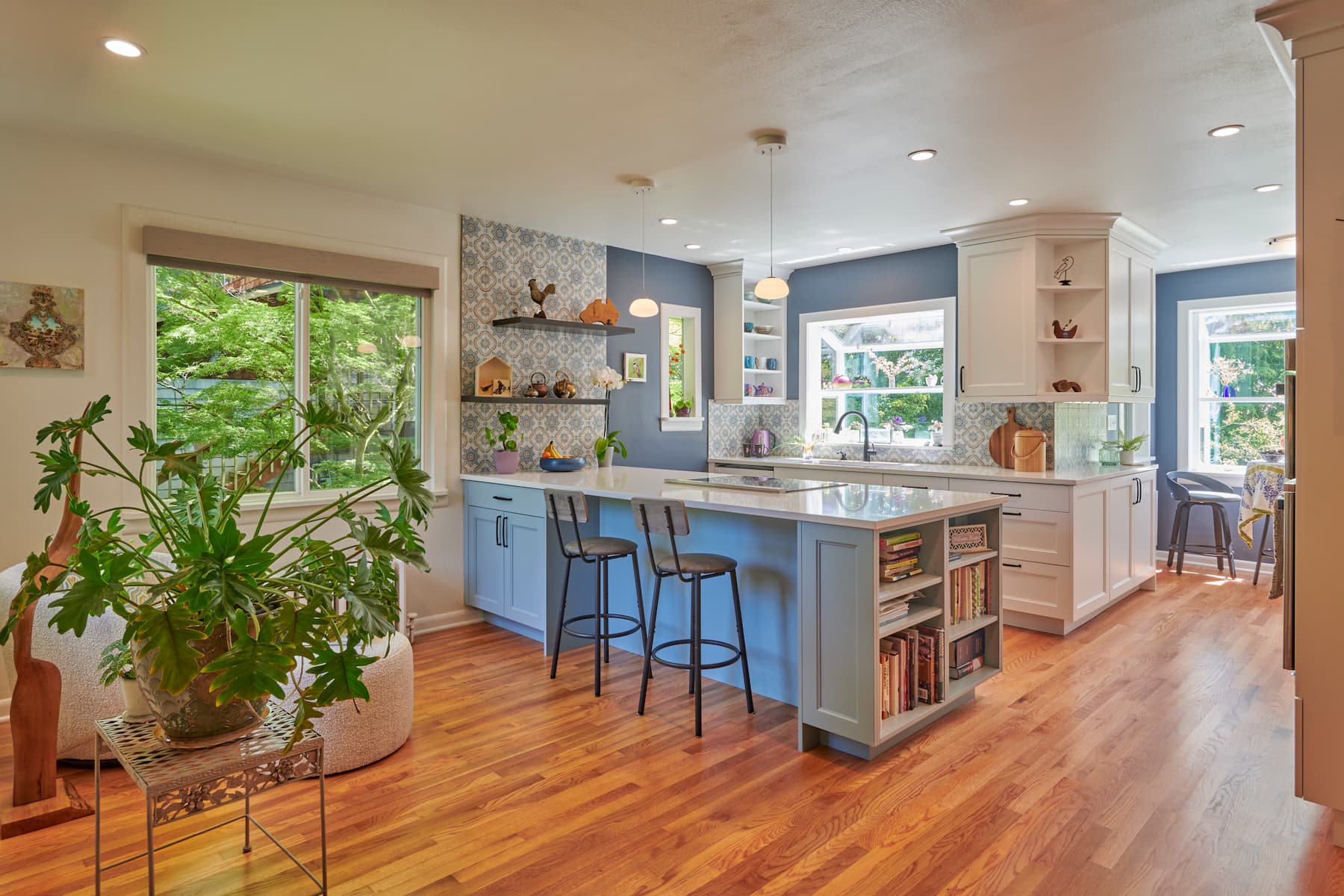
All major kitchen remodels must be permitted
In almost every circumstance, doing a full remodel of your Seattle kitchen will require permits and a full series of inspections. Notice that “permits” is plural.
Required Permits for a Kitchen Remodel in Seattle
- Plumbing permit (from King County Public Health)
- Electrical permit (from SDCI)
- Building permit (from SDCI)
Let’s take a closer look at each of these.
Plumbing Permit
In Seattle, plumbing and gas piping permits come from King County Public Health, not SDCI. As of January 1, 2026, the county charges $137 plus $27 per fixture, so a permit covering three fixtures comes to $218. Moving a gas line for a new range takes a separate gas piping permit from the same office, at $137 plus $27 per outlet.
You definitely need a plumbing permit for the type of plumbing work that takes place in a major kitchen remodel. Moving your sink from one location to another, adding plumbing for an ice maker, and adding a dishwasher are all examples of projects that would require a plumbing permit. Another upgrade that would require a plumbing permit is to switch from galvanized pipes to copper or PEX; the county treats that as a re-pipe and adds a supplemental fee based on the number of inspections. Messing with any plumbing behind the walls is going to require a permit.
Electrical Permit

You might find that there is a little room for interpretation when it comes to needing a plumbing permit, but this isn’t the case with electrical permits. SDCI says you need a permit for all electrical work, with a few exceptions. And that’s for your own safety. After all, would you really want to risk letting an unqualified person do uninspected electrical work in a wet kitchen environment? It would just be an invitation for fire, electrocution, fines, and more problems.
That said, you can swap out up to five lighting fixtures, switches, or outlets without a permit if each one is a like-for-like replacement in an existing box. If the box has no ground wire, the National Electrical Code (section 406.4(D)) doesn’t let you simply put a three-prong outlet in it; the replacement has to be GFCI protected or a two-prong outlet. Moving electrical outlets and rerouting wires always need a permit. Seattle’s code now requires GFCI protection on kitchen receptacles (the kind of outlet that cuts power in an instant if it senses a ground fault), and to keep your family safe, you should hire a licensed electrical contractor to install them. A homeowner can pull the permit only if they do the work themselves.
For a single-family kitchen, the electrical permit is usually an over-the-counter permit you get online. As of 2026, SDCI’s fee table charges a $55.48 administrative fee plus $26.28 for each new or altered circuit up to 25 amps and $43.80 for each 30 to 50 amp circuit, with a $105.12 minimum and a 5 percent technology fee on top. For example, six new 20-amp circuits and a 50-amp range circuit would come to about $270.
Building Permit (based on the value of your project)
A major kitchen remodel will require you to open up walls, remove old fixtures, flooring, and tile, and it will almost always cost more than SDCI’s $6,000 threshold. This type of work requires a building permit. Luckily, you can usually just get a STFI (subject to field inspection) permit for a kitchen remodel, because SDCI says non-structural interior alterations in single-family homes typically qualify. In 2025, SDCI issued 1,666 STFI construction permits, according to its monthly issued-permit reports. SDCI explains these permits in Tip 316, Subject-to-Field-Inspection Permits. Basically, Seattle will issue these for relatively simple projects that don’t require a full plan review.
You apply for an STFI permit online through the Seattle Services Portal. SDCI screens the application, which takes a few days, and the permit is good for 18 months once issued.
There is no flat price. SDCI bases the fee on the value of the project, and it raised construction permit fees 18 percent on January 1, 2026. Under the 2026 Fee Subtitle, an STFI permit costs the full permit fee plus a plan review fee of 40 percent of it, plus a 5 percent technology fee. That works out to about $1,610 for a kitchen valued at $50,000 and about $2,680 for one valued at $100,000. SDCI’s fee estimator gives a number for your project.
See also: From Pinterest to Permit
Hear Our Team Weigh In

Ep. 106: What Happens if You Get Caught Remodeling without a Permit? With Dave Callahan
Inspections

Inspections come with your permits. After your permit is issued, SDCI inspects the work to make sure it meets code. SDCI sends the building and electrical inspectors, and King County sends the plumbing inspector. If an inspector has to come back because work didn’t pass, SDCI charges a reinspection fee of half its $292 base rate ($146 as of 2026), and King County charges $137.
If you received a STFI building permit (see above), it will be up to the inspector to make sure you’re meeting current building codes rather than an office worker closely reviewing your plans before they get built. SDCI says your building inspector will review building code requirements on site. This can be a big time-saver, but it means the contractors you work with need to be well-versed on building codes. The inspector can require you to make any changes needed to comply, so you could have to spend extra to do the work over.
If you’ve hired a general contractor, he or she will request the inspections once all the wiring and plumbing are in place but before the walls are closed up. Electrical work has to pass a cover inspection before it goes behind a wall, and the building inspector does a framing inspection before insulation and an insulation inspection before the walls are covered. King County asks you to plan for several business days after you request a plumbing inspection, so build that into the schedule. You will need another round of inspections when your project is complete. The building inspector does the final inspection only after all related permits have received a final inspection, which means the plumbing and electrical inspectors have signed off. If all goes well, you will know you have a safe and well-built new kitchen that is code-compliant.
See also: Seattle Remodel Permits: What to Know
Avoid the unlicensed handyman trap
Because the cost of remodeling your kitchen can be high in per-square-foot terms, some homeowners are tempted to do the work themselves or hire a handyman. DIY is great, if you have the skills and the time. You do still need permits, however. Seattle’s $6,000 limit counts the value of your labor even if you do the work yourself, and homeowners can get their own electrical and plumbing permits for work they do in their own home.
Hiring a handyman can work well if he or she is skilled and is registered as a contractor. Washington requires all construction contractors to register with L&I, and you can look up any contractor’s registration before you hire. If you’re just doing a little cosmetic face lift, like painting your walls and cabinets or replacing your faucet and appliances, a handyman might be a fine choice, although the work might look like it was done by a handyman rather than a professional carpenter and qualified subcontractors. The real risk is when a handyman acts as a general contractor but offers to save you money by doing the work on the sly, without permits. It’s very unlikely (and certainly not desirable) that you could do a full kitchen remodel without upgrading the wiring, for instance; Seattle’s code calls for at least two 20-amp small-appliance circuits for kitchen counter outlets. And if a handyman offers to put in new outlets or open up the walls without the proper permits, it’s illegal, plain and simple. If you proceed with un-permitted work, you will be opening yourself up to risks.
Fixing it later costs more. King County charges $273 plus $55 per fixture for an “Already Built Construction” plumbing permit, about double the normal fee, and SDCI can add a special investigation fee on top of the permit fee. When you sell, Washington’s seller disclosure statement asks the buyer’s question directly:
Have there been any conversions, additions, or remodeling? If yes, were all building permits obtained? If yes, were all final inspections obtained?
One more reason to avoid the un-permitted route is that no reputable electrician or plumber will want to work on an illegal job. Neighbors and inspectors do notice unpermitted work: SDCI runs a violation complaint line, and it can issue a stop work order on a remodel that has no permit. If you build without a permit, SDCI says you may be fined up to $500 per day. Electricians have their licenses at stake too: the state’s penalty schedule fines electrical contractors up to $2,000 per offense for skipping a permit, and three or more citations in three years can lead L&I to suspend or revoke a license. It’s little wonder the good ones choose to avoid that risk.
See also: Why You Shouldn’t Remodel Without a Permit
Hire a reputable contractor and get permits

Luckily, following the rules and avoiding fines (or worse) is simple. A reputable remodeling contractor or design-build firm will likely take care of all the details and pull the required permits for you; in King County, a licensed plumbing contractor applies for the plumbing permit, not the homeowner. Working with a reputable company may cost a little more in the short term, but it will pay off in the long term and greatly reduce your risk. And if you want to reduce the cost per square foot of your kitchen remodel, here’s a tip: combine it with other projects in your house, like a bathroom or basement remodel. You’ll have a parade of subcontractors and inspectors coming through your door, and it’s far more cost effective to have them addressing multiple areas of your home at once.
If you have questions about permitting or anything else related to your kitchen remodeling project, we’d be happy to help. Feel free to contact us online or give us a call at 206-782-6959.